
MOTS-c benefits are studied mainly in mice and cells, where the peptide improved insulin sensitivity, exercise capacity and age-related physical decline. In people, the evidence so far only shows that the body's own MOTS-c levels shift with age, exercise and diabetes. No controlled human trial of injected MOTS-c has been published, and MOTS-c is not FDA-approved.
Search for MOTS-c benefits and you will find long lists: fat loss, endurance, longevity, better blood sugar. Some trace back to real studies. Others stretch a mouse result into a human promise.
This guide does something simpler. It takes each claimed benefit and grades it by the strongest evidence behind it: human, animal, cell or none. Then it gives a short, honest note on each. Also searched as: mots-c peptide benefits, mots c benefits, benefits of mots-c, motsc and peptide mots-c.
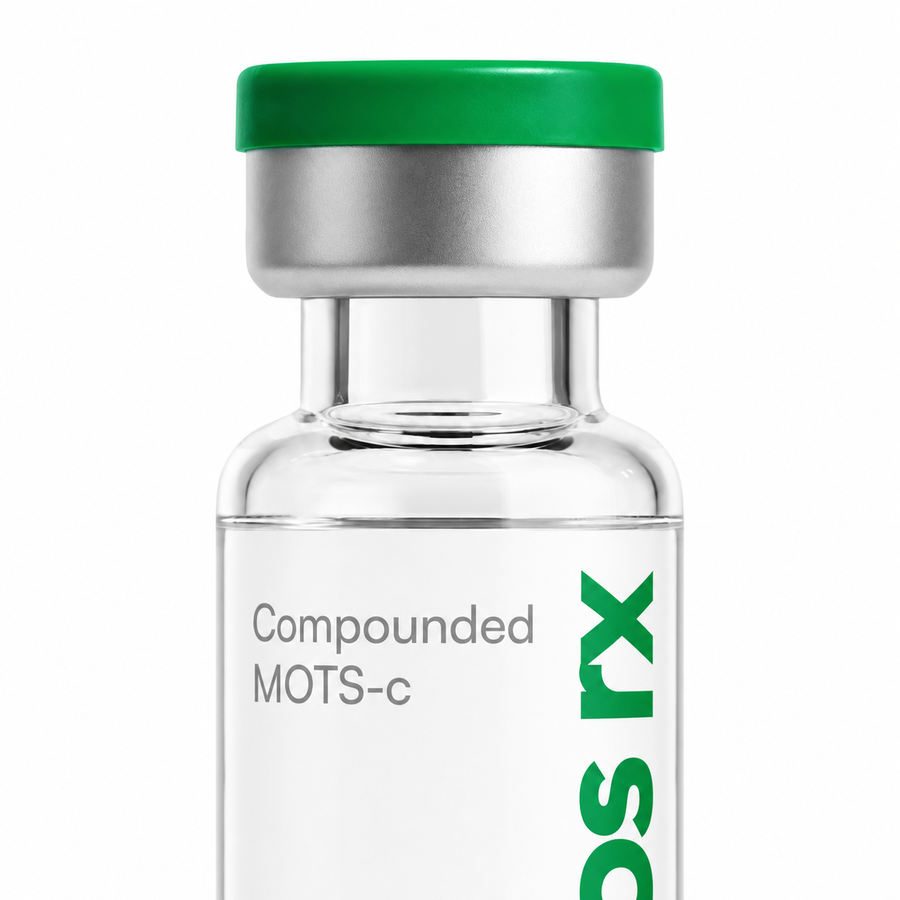
What MOTS-c is, in one paragraph
MOTS-c is a 16-amino-acid peptide encoded inside your mitochondrial DNA, in the region that codes for 12S ribosomal RNA. It was first described in 2015 by a team at the University of Southern California, who showed it targets skeletal muscle and activates AMPK, the cell's energy sensor, through effects on the folate cycle (Lee et al., 2015). It acts like a signal from the mitochondria to the rest of the body. For the fuller backstory, see our MOTS-c metabolic research overview.
How we graded each MOTS-c benefit
Each row in the scorecard below uses the highest level of evidence we could verify on PubMed:
- Human: a controlled trial in people taking MOTS-c.
- Animal: MOTS-c given to mice or rats, with a measured result.
- Cell: results in cultured cells only.
- None: no direct evidence, only theory or loose association.
Observational human data, such as blood levels in older adults, is noted in the table but does not count as "human" evidence for a treatment effect. That distinction matters more for MOTS-c benefits than for almost any other peptide.
The MOTS-c benefits scorecard
| Claimed MOTS-c benefit | Strongest evidence found | Evidence grade |
|---|---|---|
| Insulin sensitivity and glucose handling | Mice on high-fat diets and aged mice; human data are associations only (lower levels in type 2 diabetes, a gene variant linked to diabetes risk in men) | Animal |
| Weight and body fat | Diet-induced weight gain prevented in mice; in people, higher levels tracked with more liver fat, not less | Animal |
| Exercise capacity | Better running performance in young, middle-aged and old mice; exercise raises the body's own MOTS-c in people | Animal |
| Age-related physical decline | Late-life treatment in old mice improved physical capacity | Animal |
| Muscle preservation | Less muscle loss in immobilised mice | Animal |
| Bone density | Less bone loss in mice after ovary removal; reduced bone-resorbing cell formation in culture | Animal and cell |
| Inflammation | Lower inflammatory signals in mouse models of bone erosion and immobilisation | Animal |
| Cellular stress response | Moves to the nucleus and switches on antioxidant-response genes in stressed cells | Cell |
| Human lifespan or anti-aging | A gene variant in long-lived Japanese populations was proposed as a link; no treatment data | None |
| Any benefit of injected MOTS-c in people | No published controlled human trial of MOTS-c itself | None |
The pattern is clear. Not one of the MOTS-c peptide benefits reaches the "human" grade. That does not mean MOTS-c does nothing in people. It means nobody can yet say what it does, at what dose or for whom, which is why the MOTS-c protocol at telos rx is always set by a provider.
Want a licensed provider to weigh this evidence against your own health history? Complete a short online intake. A US-licensed provider reviews it asynchronously, with no scheduled appointment.
See if MOTS-c is right for youMOTS-c benefits, one by one
Insulin sensitivity and glucose handling
This is the founding claim. In the 2015 study, MOTS-c treatment in mice prevented both age-dependent and high-fat-diet-induced insulin resistance (Lee et al., 2015). A 2025 study found MOTS-c levels fall with aging in mouse pancreatic islet cells, and that treatment reduced islet cell senescence in mouse models. The same paper reported lower circulating MOTS-c in people with type 2 diabetes than in healthy controls (Kong et al., 2025).
There is also a genetic clue. An East Asian variant that changes one amino acid in MOTS-c (called K14Q) was linked to higher type 2 diabetes prevalence in men across more than 27,000 people, especially in less active men (Zempo et al., 2021). Our MOTS-c and insulin resistance guide goes deeper. Grade: animal, with supportive human associations.
Weight and body fat
Mice on a high-fat diet gained less weight with MOTS-c (Lee et al., 2015). Human data run the other way at first glance: in 125 adults without diabetes, higher plasma MOTS-c tracked with more liver and abdominal fat (Sequeira et al., 2021). The authors suggest a stress response, not a cause. Weight-related benefits of MOTS-c in people are not established. Grade: animal.
Exercise capacity
MOTS-c improved physical performance in young, middle-aged and old mice, and in people, exercise raised the body's own MOTS-c in muscle and blood (Reynolds et al., 2021). A Swedish study saw only a trend toward higher plasma MOTS-c after endurance cycling (von Walden et al., 2021). This is why it gets called an "exercise mimetic," a label our exercise mimetic explainer unpacks. For tested athletes, USADA notes that MOTS-c is prohibited at all times under WADA category S4, hormone and metabolic modulators, as an AMPK activator. Grade: animal.
Age-related physical decline
In the same 2021 study, intermittent MOTS-c started in very old mice (about 23.5 months) improved physical capacity and markers of healthspan (Reynolds et al., 2021). Healthspan is not lifespan, and old mice are not old people. Our companion piece on MOTS-c longevity and aging research covers this in detail. Grade: animal.
Muscle preservation
In mice with a leg immobilised for eight days, daily MOTS-c injections reduced muscle loss and lowered several inflammatory markers (Kumagai et al., 2024). No human study has tested MOTS-c for muscle loss. Grade: animal.
Bone density
In mice that had their ovaries removed, a model of post-menopausal bone loss, 12 weeks of MOTS-c reduced bone loss and slowed the formation of bone-resorbing cells (Ming et al., 2016). Grade: animal and cell.
Inflammation
MOTS-c reduced inflammation and bone erosion in a mouse model of particle-induced osteolysis, partly through the AMPK pathway (Yan et al., 2019). Similar anti-inflammatory signals appear in the immobilisation study above. Grade: animal.
Cellular stress response
Under metabolic stress, MOTS-c moves from the mitochondria into the nucleus and regulates genes with antioxidant response elements, interacting with the transcription factor NRF2 (Kim et al., 2018). This is the mechanism behind many of the claims above, but it was shown in cells. Grade: cell.
Longevity and anti-aging in humans
A 2015 letter proposed that a MOTS-c gene variant common in Northeast Asia might help explain exceptional longevity in Japan (Fuku et al., 2015). The authors themselves framed it as a question. There is no evidence that taking MOTS-c extends human life. Grade: none.
Curious about the MOTS-c protocol? If a provider approves it, a licensed US pharmacy compounds MOTS-c as a subcutaneous injection, and your provider sets the dose and schedule.
Learn about the MOTS-c protocolWhy human evidence for MOTS-c benefits is so thin
Three reasons come up again and again:
- It is new. MOTS-c was only described in 2015. Most peptides take decades to move from mice to large human trials.
- No published human trials. We could not find a peer-reviewed controlled trial of MOTS-c itself in people on PubMed.
- Observational data are easy to over-read. Lower MOTS-c in older or diabetic people may be a marker, not a lever.
So read any list of the benefits of MOTS-c as "studied in mice for," not "does in people."
Safety and the regulatory picture
MOTS-c is not FDA-approved for any use. Human safety data are very limited. Reported or theorised side effects include injection-site reactions, fatigue, headache, nausea and changes in blood sugar, which matters for anyone on diabetes medication. It is not for use in pregnancy or breastfeeding. Our upcoming MOTS-c side effects guide covers this in more detail.
On regulation: in July 2026, the FDA's Pharmacy Compounding Advisory Committee voted to recommend adding MOTS-c to the list of bulk substances for compounding. FDA's briefing documents had recommended against. The vote is advisory and non-binding. On October 28, 2026, HHS announced an interim enforcement discretion policy: it does not intend to take action against state-licensed pharmacies that compound single-ingredient MOTS-c for subcutaneous or intramuscular injection with a valid prescription, under strict sourcing, testing and reporting conditions. It is temporary while FDA rulemaking continues, it is not FDA approval, and HHS can revisit it. See our PCAC vote explainer and the MOTS-c legal status guide.
Grey-market vials labelled "research use only" have unverified identity, strength and sterility.
How to explore MOTS-c benefits with a provider
At telos rx, the prescription route is online and asynchronous:
- Online intake. You answer questions about your health, medications and goals.
- Provider review. A US-licensed provider reviews your answers without a scheduled appointment. A prescription is required, subject to medical approval by a licensed provider, and approval is not guaranteed.
- Licensed pharmacy. If approved, a licensed US pharmacy compounds MOTS-c as a subcutaneous injection. Your provider sets the dose and schedule.
- Ongoing care. You can message the care team, and plans can be cancelled from the portal.
telos rx does not offer oral or tablet MOTS-c. You can read more on the MOTS-c page, or compare it with a related cellular-energy option in our MOTS-c vs NAD+ comparison.
Frequently asked questions about MOTS-c benefits
What are the main MOTS-c benefits studied so far?
The MOTS-c benefits studied most are better insulin sensitivity, resistance to diet-induced weight gain, improved exercise capacity and less age-related physical decline. Almost all of it comes from mouse and cell studies.
Are MOTS-c benefits shown in humans?
No. Human evidence is limited to observational studies of the body's own MOTS-c levels, such as lower levels in older men and in people with type 2 diabetes. These studies show associations, not the effect of taking MOTS-c.
What are the benefits of MOTS-c for weight loss?
In mice fed a high-fat diet, MOTS-c treatment prevented diet-induced weight gain. Weight loss benefits in humans are not established.
Is mots c the same as MOTS-c?
Yes. mots c, motsc, mots-c peptide and peptide mots-c all refer to the same 16-amino-acid mitochondrial-derived peptide, first described in 2015.
Is MOTS-c FDA-approved?
No. MOTS-c is not FDA-approved for any use. In July 2026 an FDA advisory committee voted to recommend adding it to the list of bulk substances for compounding, but that vote is non-binding. On October 28, 2026, HHS announced a temporary enforcement discretion policy for compounded single-ingredient MOTS-c under strict conditions while FDA rulemaking continues. That policy is not FDA approval.
Can athletes use MOTS-c?
Tested athletes should not. According to USADA, MOTS-c is prohibited at all times under WADA category S4, hormone and metabolic modulators, as an AMPK activator. Check with your own federation too.
How can I find out if MOTS-c is right for me?
At telos rx, you complete an online intake that a US-licensed provider reviews asynchronously. If appropriate, a licensed US pharmacy compounds MOTS-c as a subcutaneous injection. Every prescription is subject to medical approval by a licensed provider, and approval is not guaranteed.
You now know which MOTS-c benefits rest on mouse data and which rest on nothing yet. If you want a licensed provider to decide whether MOTS-c fits you, start a short online intake.
Explore MOTS-c at telos rxThis article is for general education and is not medical advice. MOTS-c is not FDA-approved for any use, and compounded MOTS-c has not been evaluated by the FDA for safety, effectiveness or quality. All prescriptions are subject to medical approval by a licensed provider; approval is not guaranteed. Individual experiences vary. telos rx is an online-first, asynchronous telehealth service, and medications are compounded by a licensed US pharmacy. MOTS-c is prohibited in sport under WADA category S4.