
There is no evidence-based MOTS-c cycle for humans. Cycle lengths shared online are borrowed from mouse studies, forums and vendor pages, not from controlled human trials. If MOTS-c is prescribed, a licensed provider sets how long you take it, whether you take breaks, and when the plan gets reviewed.
A MOTS-c cycle is one of the most searched questions about this peptide, and one of the least settled. Ask five sources and you will get five different answers, each delivered with total confidence.
This guide does not hand you a schedule. Instead, it explains what "cycling" actually means, why the numbers you see online have no real foundation, and how a provider decides duration and review points for a real person. Also searched as: mots c cycle, motsc cycle, mots-c peptide cycle and peptide mots-c on and off.
What a MOTS-c cycle actually means
In peptide circles, a "cycle" is a block of time on a compound, often followed by a planned break. People talk about the MOTS-c cycle the same way they talk about cycles for other peptides: so many weeks on, so many weeks off, then repeat.
That framing comes from habit, not from MOTS-c research. There are really three separate questions bundled together:
- Duration: how long a single block of use lasts.
- Frequency: how often doses happen within that block.
- Breaks: whether there is time off, and how long it lasts.
For an approved medicine, all three would come from clinical trials and a prescribing label. MOTS-c has neither. It is not FDA-approved for any use, so there is no label, and there are no large human trials to write one from.
Why online MOTS-c cycle lengths are not evidence-based
MOTS-c is a 16-amino-acid peptide encoded in the mitochondrial genome, first described in 2015 (Lee et al., 2015). That paper, and much of what followed, was done in mice and cultured cells. It found that MOTS-c acted on skeletal muscle and was linked to AMPK activation and insulin sensitivity in animals.
Important research, but it does not tell anyone how long a person should use the peptide. Here is why the MOTS-c cycle advice you find online falls short:
| Where the cycle claim comes from | What it is based on | Why it is not a human standard |
|---|---|---|
| Mouse studies | Lab protocols in young, middle-aged or old mice | Mouse lifespans, metabolism and doses do not scale neatly to people |
| Forums and social posts | Personal experience and repetition | No control group, unverified products, no consistent measurement |
| Vendor pages | Copied schedules, often for grey-market vials | Commercial motive, products labelled "research use only" |
| Borrowed from other peptides | Habits from unrelated compounds | Different molecules behave differently |
Notice what is missing from that table: controlled human trials. That is the whole story of the MOTS-c cycle question. Every number in circulation is a guess, however confidently it is presented.
Want a licensed provider to decide what makes sense for you, instead of a forum? Complete a short online intake. A US-licensed provider reviews it asynchronously, with no scheduled appointment.
See if MOTS-c is right for youWhere the "on and off" idea comes from
The MOTS-c on and off pattern did not appear from nowhere. One of the better-known studies, from the same research group that discovered the peptide, reported that intermittent MOTS-c treatment, given three times a week, was linked to greater physical capacity in old mice (Reynolds et al., 2021). The same paper reported that exercise raised the body's own MOTS-c in human muscle and blood.
People then stretched that into a human MOTS-c cycle. But "intermittent" in a mouse study describes a lab protocol, not a recommendation for a person. The study did not compare cycling against continuous use in humans, and it did not test injected MOTS-c in people at all.
There is also a mechanistic idea behind cycling. MOTS-c can move into the cell nucleus under metabolic stress and influence gene expression in cell and animal work (Kim et al., 2018). Some people reason that the body might adapt to a constant signal, so breaks could help. That is a reasonable hypothesis. It has not been tested in humans.
For the broader exercise story, see our explainer on MOTS-c as an exercise mimetic. If you compete in tested sport, note that MOTS-c is named on the WADA Prohibited List as an AMPK activator, prohibited at all times. Check the current list and your federation before using it.
How long to take MOTS-c: how a provider decides
So if there is no standard MOTS-c cycle length, how does anyone decide? At telos rx, the answer is a licensed provider, working from your health history rather than a template. Duration is treated as part of an ongoing plan, not a fixed countdown. You can read how the MOTS-c protocol at telos rx is structured before you start.
These are the kinds of factors a provider weighs:
- Your health history. Conditions such as diabetes, kidney or liver issues, and any history of low blood sugar.
- Current medications. MOTS-c is studied for effects on glucose handling, which matters if you take diabetes medication.
- Your goals. What you hope to support, and whether those goals are realistic given the limited evidence.
- Tolerance. How you respond, including injection-site reactions, fatigue, headache or nausea.
- Life stage. MOTS-c is not for use in pregnancy or breastfeeding.
From there, your provider sets the dose and schedule, and decides whether a planned break makes sense. Our guide on how providers dose MOTS-c goes deeper on the dosing side. For safety detail, see the MOTS-c side effects overview.
Review points: what a MOTS-c cycle check-in looks at
A responsible MOTS-c cycle has review points built in. These are moments when you and your provider check whether the plan still fits. The timing is set by your provider and depends on your situation, not on a fixed calendar from the internet.
A review might look at:
- Any side effects or changes you have noticed, good or bad.
- Changes to your health or medications since you started.
- Whether to continue, adjust, pause or stop.
- Whether you want to keep going at all. Plans can be cancelled from the portal.
There is also no evidence-based answer to how quickly anyone should notice anything. We cover that honestly in how long MOTS-c takes to work. The short version: no research-backed timeline exists for humans, so reviews focus on how you are doing, not on hitting a date.
A MOTS-c cycle at telos rx is set by a licensed provider and reviewed over time, subject to medical approval by a licensed provider. Approval is not guaranteed.
Learn about the MOTS-c protocolRed flags in MOTS-c cycle advice
When you read about a MOTS-c cycle online, a few warning signs are worth knowing:
- Exact numbers with no source. If a schedule is precise but cites nothing, it is a guess.
- Promised results by a date. No human research supports a results timeline for MOTS-c.
- A product link next to the schedule. Grey-market vials sold as "research use only" are not made for human use, and their identity, purity and strength are unverified.
- Stacking plans built for everyone. A schedule that ignores your medications and history is not a medical plan.
If you are curious about the underlying science instead, our deep dive on MOTS-c metabolic research lays out what the studies show and where they stop.
How MOTS-c is prescribed at telos rx
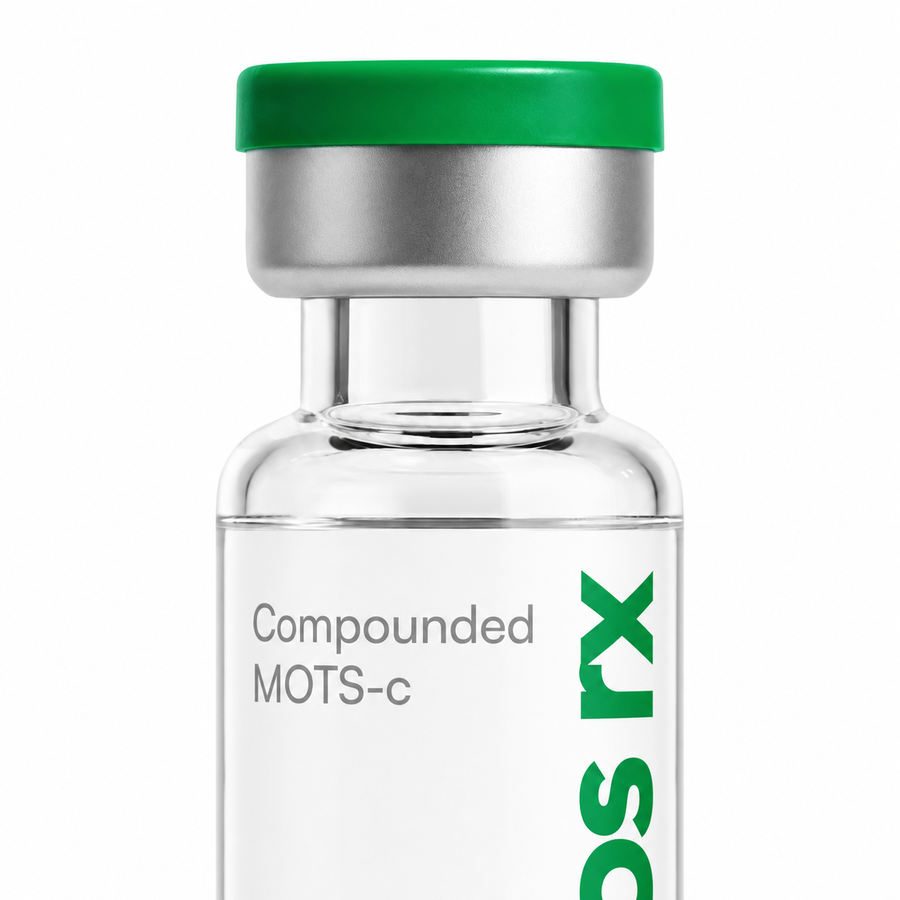
telos rx offers compounded MOTS-c through a prescription route. Here is how it works:
- Online intake. You answer questions about your health, medications and goals.
- Asynchronous provider review. A US-licensed provider reviews your answers, with no scheduled appointment. A prescription is required, and approval is not guaranteed.
- Licensed pharmacy. If approved, a licensed US pharmacy compounds MOTS-c as a subcutaneous injection. Your provider sets the dose, schedule and any planned breaks.
- Ongoing review. You can message the care team, and plans can be cancelled from the portal.
telos rx does not offer oral or tablet MOTS-c. On regulation, MOTS-c is not FDA-approved. In July 2026 an FDA advisory committee voted to recommend adding it to the compounding bulk substances list, an advisory and non-binding step. On October 28, 2026, HHS announced a temporary enforcement discretion policy that covers single-ingredient subcutaneous or intramuscular MOTS-c compounded by state-licensed pharmacies with a valid prescription, under strict sourcing, testing and reporting conditions (Federal Register notice). It is not FDA approval, and HHS can revisit it. Read our PCAC vote explainer and the MOTS-c legal status guide. Full details are on the MOTS-c page.
Frequently asked questions about the MOTS-c cycle
What is a typical MOTS-c cycle?
There is no typical MOTS-c cycle backed by human research. Cycle lengths shared online come from forums, vendor pages and extrapolated mouse studies, not from controlled human trials. At telos rx, a licensed provider sets the duration and schedule for each person and reviews it over time.
How long is a MOTS-c cycle length usually?
No evidence-based MOTS-c cycle length exists for people. Published research is mostly in mice and cells, and those protocols do not translate directly into a human duration. Any length you see quoted online is an opinion, not a clinical standard.
How long to take MOTS-c before stopping?
How long to take MOTS-c is a provider decision. It depends on your health history, other medications, how you tolerate it and what you and your provider agree to review. There is no research-defined stopping point for humans.
Do people take MOTS-c on and off?
Some people describe taking MOTS-c on and off, with breaks between blocks. The idea is borrowed from mouse studies that used intermittent dosing, but no human trial has compared continuous use with cycling. Whether you take breaks, and when, is set by your provider.
Why does MOTS-c cycle advice vary so much online?
Because there is no human data to anchor it. Without controlled trials, each source fills the gap with its own guess. That is why one forum suggests short blocks and another suggests months of use. Neither is evidence-based.
Is MOTS-c allowed for athletes?
No. MOTS-c is named on the WADA Prohibited List as an example of an AMPK activator under hormone and metabolic modulators, prohibited at all times. Tested athletes should check the current list and their federation rules before using any peptide.
Is MOTS-c FDA-approved?
No. MOTS-c is not FDA-approved for any use. In July 2026 an FDA advisory committee voted to recommend adding it to the list of bulk substances for compounding, but that vote is advisory and non-binding, pending FDA rulemaking. A temporary HHS enforcement discretion policy announced October 28, 2026 covers injectable MOTS-c compounded under strict conditions while rulemaking continues, which is also not FDA approval.
Skip the guesswork on your MOTS-c cycle. Start a short online intake and let a licensed provider decide what fits your health history.
Explore MOTS-c at telos rxThis article is for general education and is not medical advice. MOTS-c is not FDA-approved for any use, and compounded MOTS-c has not been evaluated by the FDA for safety, effectiveness or quality. No evidence-based cycle length, dose or results timeline has been established for humans. All prescriptions are subject to medical approval by a licensed provider; approval is not guaranteed. Individual experiences vary. telos rx is an online-first, asynchronous telehealth service, and medications are compounded by a licensed US pharmacy. MOTS-c is prohibited in sport under the WADA Prohibited List.