
The KPV peptide is a tiny three-amino-acid chain, lysine, proline and valine, taken from the tail end of a natural hormone called alpha-MSH. It is studied, almost entirely in cells and animals, for how it may calm inflammatory signalling in the gut, skin and airways. KPV is not FDA-approved for any use, and no controlled human trials have been published.
If you have seen the KPV peptide pop up in gut-health forums or skincare threads, the claims can sound big. This guide keeps it simple: what KPV is, where it comes from, what it is studied for, how strong the evidence really is, where it stands legally in the US, and how people access it through a prescription.
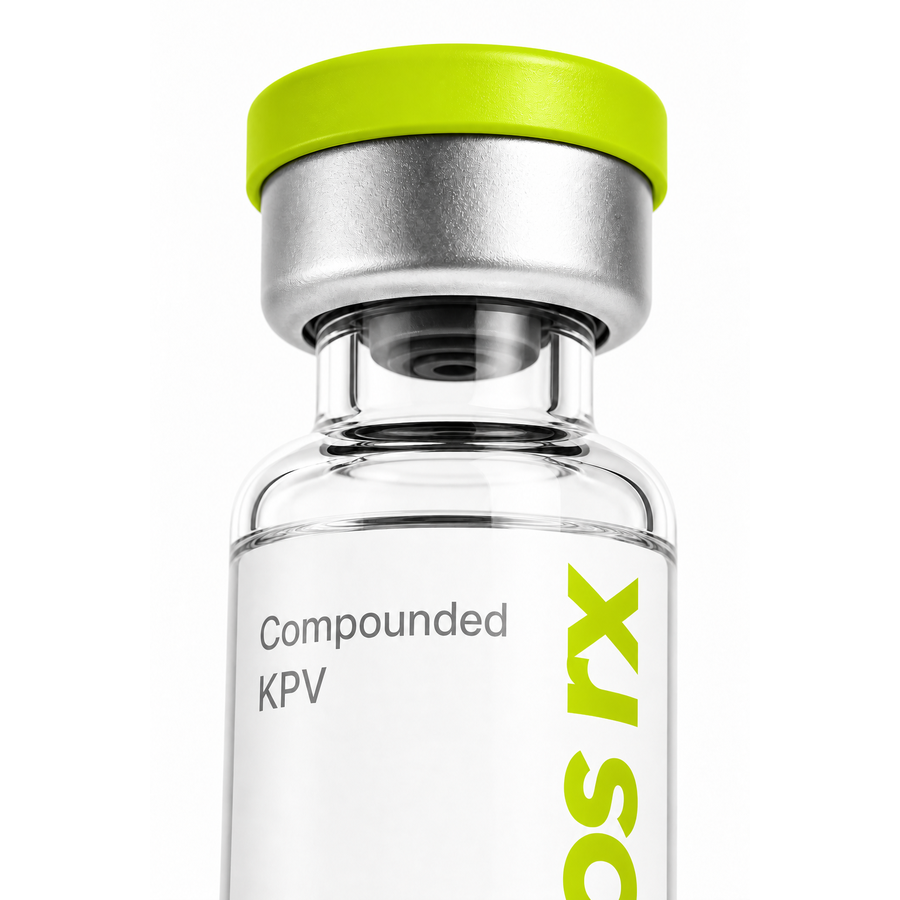
What is KPV peptide?
KPV is a tripeptide, which means it is made of just three amino acids joined together. The letters are the standard one-letter codes for those amino acids:
- K is lysine.
- P is proline.
- V is valine.
Written out, that is Lys-Pro-Val. You will see the same molecule called peptide KPV, alpha-MSH 11-13, or simply KPV. When people talk about "KPV peptides" in the plural, they usually mean KPV itself plus a few lab-made variants, such as versions with a D-form valine or two KPV units linked together.
The short answer to "what is KPV peptide" is this: a very small fragment of a larger hormone, studied for one specific job, dampening inflammation.
Where the KPV peptide comes from: alpha-MSH
Your body makes a hormone called alpha-melanocyte-stimulating hormone, or alpha-MSH. It is 13 amino acids long and is best known for its role in skin pigmentation. It also has well-documented anti-inflammatory effects in lab and animal studies.
KPV is the last three amino acids of alpha-MSH, positions 11, 12 and 13. Researchers zoomed in on this fragment for a practical reason. A major review in Endocrine Reviews explained that the pigment-darkening effect of alpha-MSH is an obstacle to using it against inflammation, while KPV appears to keep anti-inflammatory activity without that pigment action (Brzoska et al., 2008).
Curious whether the KPV peptide fits your health history? Complete a short online intake. A US-licensed provider reviews it asynchronously, with no scheduled appointment, and decides whether a prescription is appropriate.
See if KPV is right for youHow the KPV peptide is thought to work
Inflammation is driven by chemical switches inside cells. One of the most important is NF-kB, a protein complex that turns on genes for inflammatory messengers called cytokines. Much of the KPV research focuses on this switch.
Getting inside cells through PepT1
A 2008 study in Gastroenterology found that KPV is carried into intestinal and immune cells by PepT1, a transporter that normally moves small peptides from food. PepT1 is usually found in the small intestine but appears in the colon during inflammatory bowel disease. In human cell lines, nanomolar amounts of KPV reduced NF-kB and MAP kinase signalling and lowered inflammatory cytokine release (Dalmasso et al., 2008).
Blocking an inflammatory signal from reaching the nucleus
In human airway cells grown in the lab, KPV reduced NF-kB activity and the release of inflammatory chemokines. The author linked this to KPV entering the nucleus and interfering with the import of p65, a key part of NF-kB (Land, 2012). Put simply, the KPV peptide may stop an "inflame" message from being delivered.
Whether KPV acts the same way in people has not been tested. These are mechanisms seen in cells and animals.
What is the KPV peptide studied for?
Research clusters around a few themes. Here is a quick map, with the type of evidence behind each one.
| Research theme | What was looked at | Type of evidence |
|---|---|---|
| Gut inflammation | KPV in drinking water in mouse colitis models; colon-targeted nanoparticles | Animal, cell |
| Airway inflammation | NF-kB and chemokine signalling in human bronchial cells | Cell |
| Skin and wounds | Keratinocyte signalling; corneal wound closure in rabbits | Cell, animal |
| Antimicrobial activity | S. aureus and C. albicans growth in the lab | Cell (in vitro) |
Key results behind that table:
- In two mouse colitis models, KPV given in drinking water reduced inflammation and inflammatory cytokine levels (Dalmasso et al., 2008). A separate team saw faster recovery and less inflammatory infiltrate in mice with colitis, partly independent of the MC1R receptor (Kannengiesser et al., 2008).
- KPV loaded into hyaluronic-acid-coated nanoparticles and given orally in a hydrogel reduced colitis damage in mice (Xiao et al., 2017).
- Eye drops containing KPV sped corneal surface repair in rabbits (Bonfiglio et al., 2006).
- Alpha-MSH and KPV reduced growth of Staphylococcus aureus and Candida albicans in lab tests (Cutuli et al., 2000).
For a closer look, see our guides on KPV anti-inflammatory research and KPV and gut health research. For a use-by-use breakdown, our companion piece on what KPV does and its uses goes goal by goal.
How strong is the evidence on KPV peptides?
Honestly, it is early. We searched PubMed and the ClinicalTrials.gov registry and could not find a published controlled human trial of KPV. Everything above comes from cultured cells and animals.
That gap matters for three reasons:
- No established human dose. Animal doses do not translate neatly to people, so online dosage charts for the KPV peptide are not evidence-based.
- No measured benefit in people. Calmer cytokines in a mouse colon do not show the same result in a human gut.
- Limited safety data. Short-term animal work is not a long-term human safety profile.
Many of the gut studies also come from a small number of research groups, so independent replication is still limited. If you want to compare KPV with a better-known peptide, our KPV vs BPC-157 comparison sets the two side by side.
Want a licensed provider to weigh this early evidence against your own history? KPV at telos rx is compounded by a licensed US pharmacy and prescribed only after an online provider review.
Learn about the KPV protocolKPV peptide legal status in the US
KPV is not FDA-approved for any condition. Compounded KPV has not been evaluated by the FDA for safety, effectiveness or quality.
In July 2026, the FDA's Pharmacy Compounding Advisory Committee voted to recommend adding KPV, along with several other peptides, to FDA's list of bulk substances that may be used in compounding. The KPV vote was 8 for, 6 against, with one abstention. FDA's own briefing documents had recommended against. The vote was advisory and non-binding. Then, on October 28, 2026, HHS announced an interim enforcement discretion policy covering six peptides, KPV among them. Under it, HHS does not intend to take enforcement action against state-licensed pharmacies or licensed physicians that compound KPV for a patient with a valid prescription, as long as strict conditions are met, including FDA-registered suppliers, lot-level testing, single-ingredient products and adverse event reporting. For KPV the policy covers topical and oral forms only, not injections. It is temporary while FDA decides through rulemaking, it is not FDA approval, and HHS can revisit it if safety or quality problems arise. Our PCAC vote explainer walks through what that means, and the upcoming guide on whether KPV is FDA-approved will track the status.
KPV and sport
As far as we know, KPV is not named on the WADA Prohibited List. However, WADA's S0 category covers substances with no current approval for human therapeutic use. If you are a tested athlete, check the current WADA list and your federation before considering any peptide.
Safety basics
Human safety data for KPV are very limited. Anyone who is pregnant, breastfeeding, managing an autoimmune condition or taking immune-modifying medication should raise that with a provider. Our planned guide to KPV side effects and safety will go deeper.
How people access the KPV peptide with a prescription
There are two very different markets for KPV. One is grey-market vials, capsules and creams labelled "research use only," sold with a disclaimer and no medical oversight. Their identity, purity and sterility are unverified. Our guide on how to read a peptide COA shows why paperwork alone is not enough.
The other route is a prescription. Here is how it works at telos rx:
- Online intake. You answer questions about your health, medications and goals.
- Asynchronous provider review. A US-licensed provider reviews your answers, with no scheduled appointment. A prescription is required, and approval is not guaranteed.
- Licensed pharmacy. If approved, a licensed US pharmacy compounds KPV. Your provider sets the dose, form and schedule.
- Ongoing support. You can message the care team with questions as you go.
Because there is no established human dose, a provider works from your history rather than an internet chart. Our planned guide on how providers dose KPV explains that process. Full details are on the KPV page.
Summary: the KPV peptide at a glance
The KPV peptide is the Lys-Pro-Val tail of alpha-MSH, studied for calming NF-kB and cytokine signalling in gut, airway and skin models, with some antimicrobial activity in the lab. The science is interesting, but it is cell and animal work, with no published controlled human trials. KPV is not FDA-approved. Since October 28, 2026 a temporary HHS enforcement discretion policy covers compounded KPV in topical and oral forms, under strict conditions, while FDA rulemaking continues. If you are curious, the safest route is a licensed provider who can review your history. You can explore KPV at telos rx to see how that works.
KPV peptide FAQ
What is KPV peptide in simple terms?
KPV peptide is a three-amino-acid chain, lysine, proline and valine, cut from the tail end of a natural hormone called alpha-MSH. It is studied in cells and animals for calming inflammatory signalling, especially in the gut and skin. KPV is not FDA-approved for any use.
Is the KPV peptide the same as alpha-MSH?
No. KPV is only the last three amino acids (positions 11 to 13) of alpha-MSH, which is 13 amino acids long. Researchers studied it because it appears to keep much of the anti-inflammatory signal of alpha-MSH without the skin-darkening effect.
What does the name KPV stand for?
KPV is simply the one-letter code for its three amino acids: K for lysine, P for proline and V for valine. You may also see it written as Lys-Pro-Val, alpha-MSH 11-13, peptide KPV or KPV peptides.
Has KPV been tested in humans?
We could not find any published controlled human trial of KPV. The evidence comes from cell cultures and animal models, such as mouse colitis and rabbit corneal studies. That means no established human dose, benefit or long-term safety profile exists.
Is KPV FDA-approved?
No. KPV is not FDA-approved for any use. In July 2026 an FDA advisory committee voted 8 to 6, with one abstention, to recommend adding KPV to the list of bulk substances for compounding. That vote was non-binding. On October 28, 2026, HHS announced a temporary enforcement discretion policy that covers compounded KPV in topical and oral forms only, under strict conditions, while FDA rulemaking continues. It is not FDA approval.
Is KPV banned in sport?
KPV is not named on the WADA Prohibited List as far as we know, but substances without regulatory approval for human use can fall under the S0 category. Tested athletes should check the current WADA list and their federation before considering it.
How do people get the KPV peptide with a prescription?
At telos rx you complete an online intake that a US-licensed provider reviews asynchronously, with no scheduled appointment. If appropriate, a licensed US pharmacy compounds KPV and your provider sets the dose, form and schedule. It is subject to medical approval by a licensed provider, and approval is not guaranteed.
Now you know what the KPV peptide is and where the evidence stops. If you want a licensed provider to decide whether it fits you, start a short online intake.
Explore KPV at telos rxThis article is for general education and is not medical advice. KPV is not FDA-approved for any use, and compounded KPV has not been evaluated by the FDA for safety, effectiveness or quality. All prescriptions are subject to medical approval by a licensed provider; approval is not guaranteed. Individual experiences vary. telos rx is an online-first, asynchronous telehealth service, and medications are compounded by a licensed US pharmacy. Tested athletes should check the current WADA Prohibited List.