
The MOTS-c peptide is a short, 16-amino-acid signalling molecule encoded in your mitochondrial DNA, not in the nucleus like most proteins. It is studied, mostly in mice and cell cultures, for its role in insulin sensitivity, glucose handling and how muscles respond to exercise. MOTS-c is not FDA-approved for any use, and human evidence for injected MOTS-c is minimal.
If you have seen the MOTS-c peptide mentioned on a podcast or a longevity forum, you have probably heard big claims. This guide strips it back to what the research actually says: what the molecule is, where it comes from, how it signals, how strong the evidence is, and how people access it through a prescription.
Also searched as: mots c, motsc peptide, mots c peptide, peptide mots-c, mots, and the misspelling motc peptide.
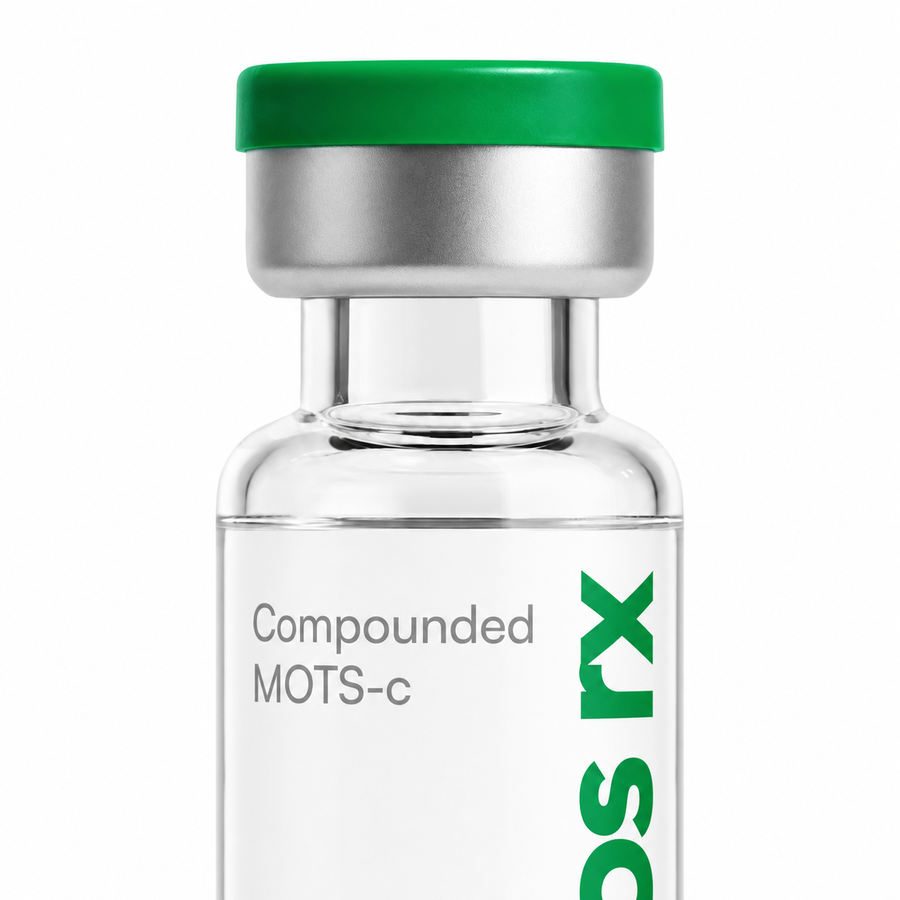
What is the MOTS-c peptide?
MOTS-c stands for mitochondrial open reading frame of the 12S rRNA type-c. That long name tells you where it lives. Mitochondria, the energy-producing structures inside your cells, carry their own small genome. Tucked inside one of its genes, the 12S ribosomal RNA, is a short stretch of code that produces a 16-amino-acid peptide.
That peptide is MOTS-c. It was first described in 2015 by a team at the University of Southern California (Lee et al., 2015, Cell Metabolism). The finding mattered because it suggested mitochondria are not just power plants. They may also send chemical messages to the rest of the body.
Three facts frame everything else about the MOTS-c peptide:
- It is natural. Your cells make small amounts of it. Compounded MOTS-c is a synthetic copy of the same sequence.
- It is tiny. At 16 amino acids, it is far smaller than insulin or growth hormone.
- It is a signal. It is studied for what it tells cells to do, mainly around fuel use and stress.
Where MOTS-c comes from: the mitochondrial genome
Most of your genes sit in the cell nucleus. Mitochondria keep a separate, much smaller set of genes, inherited from your mother. For decades, scientists thought this little genome only coded for parts of the energy machinery.
That view changed with the discovery of mitochondrial-derived peptides. Humanin came first, then MOTS-c. Both are short sequences hidden inside mitochondrial genes. Our explainer on mitochondrial-derived peptides, MOTS-c and humanin covers the family in more depth, and the MOTS-c vs humanin comparison sets the two side by side.
Curious whether the MOTS-c peptide fits your health history? Complete a short online intake. A US-licensed provider reviews it asynchronously, with no scheduled appointment, and decides whether a prescription is appropriate.
See if MOTS-c is right for youHow the MOTS-c peptide signals
In the 2015 mouse and cell work, MOTS-c appeared to act mainly on skeletal muscle. Inside cells, it slowed the folate cycle and a linked pathway that builds purines. That build-up of an intermediate called AICAR switched on AMPK, an enzyme often described as the cell's fuel gauge (Lee et al., 2015).
AMPK matters because it nudges cells toward taking up glucose and burning fuel more efficiently. It is the same broad pathway that exercise activates, which is why MOTS-c is sometimes called an "exercise mimetic." We unpack that label, and its limits, in MOTS-c as an exercise mimetic.
The MOTS-c peptide can reach the nucleus
A 2018 study added a twist. Under metabolic stress, such as low glucose, cells moved MOTS-c from the mitochondria into the nucleus. There it influenced the expression of genes involved in stress resistance (Kim et al., 2018, Cell Metabolism). In simple terms, the mitochondria appeared to talk directly to the cell's main genome.
What is the MOTS-c peptide studied for?
Research on the MOTS-c peptide clusters around a handful of themes. Here is a quick map, with the type of evidence behind each.
| Research theme | What was looked at | Type of evidence |
|---|---|---|
| Insulin sensitivity | Prevention of diet-induced and age-related insulin resistance in mice | Animal |
| Body weight | Less weight gain in mice on a high-fat diet | Animal |
| Physical capacity | Running performance in young, middle-aged and old mice | Animal |
| Exercise response | Natural MOTS-c levels in muscle and blood after exercise | Human, observational |
| Ageing | Natural MOTS-c levels across age groups | Human, observational |
Key results behind that table:
- In mice, MOTS-c treatment prevented age-dependent and high-fat-diet insulin resistance and diet-induced obesity (Lee et al., 2015).
- In mice of several ages, MOTS-c improved physical performance. In humans, exercise raised natural MOTS-c in muscle and in circulation (Reynolds et al., 2021, Nature Communications).
- In healthy men, circulating MOTS-c was lower with age, while muscle levels were higher in older groups (D'Souza et al., 2020, Aging).
For a deeper look at the metabolic research, see MOTS-c and metabolic research and MOTS-c for insulin resistance research. If you want the use-case view, our companion guide on what the MOTS-c peptide is used for goes goal by goal.
How strong is the evidence on the MOTS-c peptide?
Honestly, it is early. Almost everything known about what the MOTS-c peptide does comes from mice and cultured cells. The human studies so far measure the body's own MOTS-c, not the effect of injecting it.
That distinction matters. Seeing that exercise raises natural MOTS-c does not show that adding extra MOTS-c gives the benefits of exercise. No controlled human trial has established a dose, a benefit or a long-term safety profile for injected MOTS-c.
It is also worth knowing that two of the senior researchers on several key papers disclosed consulting and shareholding roles with a company developing mitochondrial peptide drugs, as listed in the published conflict-of-interest statements. That does not make the work wrong, but independent replication is still limited.
Want a licensed provider to weigh this early evidence against your own history? MOTS-c at telos rx is compounded by a licensed US pharmacy and prescribed only after an online provider review.
Learn about the MOTS-c protocolMOTS-c peptide legal status
MOTS-c is not FDA-approved for any condition. Compounded MOTS-c has not been evaluated by the FDA for safety, effectiveness or quality.
In July 2026, the FDA's Pharmacy Compounding Advisory Committee voted to recommend adding MOTS-c, along with several other peptides, to the list of bulk substances that may be used in compounding. FDA's own briefing documents had recommended against. The vote is advisory and non-binding. On October 28, 2026, HHS announced an interim enforcement discretion policy that includes MOTS-c: HHS does not intend to take enforcement action against state-licensed pharmacies that compound single-ingredient MOTS-c for subcutaneous or intramuscular injection with a valid prescription, if strict sourcing, testing and reporting conditions are met. It is temporary while FDA decides through rulemaking, it is not FDA approval, and HHS can revisit it. The accurate status is "interim enforcement discretion, pending FDA rulemaking." Our PCAC vote explainer walks through what that means, and the planned guide on whether MOTS-c is FDA-approved will track the status.
MOTS-c and sport
The U.S. Anti-Doping Agency states that MOTS-c is prohibited at all times under the WADA Prohibited List section for metabolic modulators, as an AMPK activator (USADA). Tested athletes should check the current WADA list and their federation before considering it.
Safety basics
Human safety data for injected MOTS-c are very limited. Reported or theorised effects include injection-site reactions, fatigue, headache, nausea and changes in blood sugar, which matters for anyone on diabetes medication. It is not for use in pregnancy or breastfeeding. A provider decides whether it is appropriate. See our upcoming MOTS-c side effects guide for more.
How people access the MOTS-c peptide with a prescription
There are two very different markets for the MOTS-c peptide. One is grey-market vials labelled "research use only," sold with a disclaimer and no medical oversight. Their identity, purity and sterility are unverified. Our guide on how to read a peptide COA shows why paperwork alone is not enough.
The other is a prescription. Here is how it works at telos rx:
- Online intake. You answer questions about your health, medications and goals.
- Asynchronous provider review. A US-licensed provider reviews your answers, with no scheduled appointment. A prescription is required, and approval is not guaranteed.
- Licensed pharmacy. If approved, a licensed US pharmacy compounds MOTS-c as a subcutaneous injection. Your provider sets the dose and schedule.
- Ongoing support. You can message the care team, and plans can be cancelled from the portal.
telos rx does not offer MOTS-c tablets or any oral form. There is no established human dose for MOTS-c, so online dosage charts are not evidence-based. Our planned guide on how providers dose MOTS-c explains how a provider approaches it. Full details are on the MOTS-c page.
Summary: the MOTS-c peptide at a glance
The MOTS-c peptide is a mitochondrial-encoded signal studied for metabolism, insulin sensitivity and the exercise response. The science is genuinely interesting, but it is mostly animal and cell work, and human evidence for injected MOTS-c is minimal. MOTS-c is not FDA-approved, and its compounding status is pending FDA rulemaking, with an interim HHS enforcement discretion policy in place since October 28, 2026. If you are curious, the safest route is a licensed provider who can review your history.
MOTS-c peptide FAQ
What is the MOTS-c peptide in simple terms?
The MOTS-c peptide is a 16-amino-acid signal encoded in the DNA of your mitochondria rather than in the cell nucleus. It is studied, mainly in mice and cells, for its role in insulin sensitivity, glucose handling and the metabolic response to exercise. MOTS-c is not FDA-approved for any use.
Is MOTS c the same as MOTS-c?
Yes. MOTS c, motsc, mots c peptide and peptide mots-c all refer to the same mitochondrial-derived peptide. The name stands for mitochondrial open reading frame of the 12S rRNA type-c. Some people also shorten it to just mots.
What does the MOTS-c peptide do in the body?
In animal and cell studies, MOTS-c is linked to AMPK activation through effects on the folate cycle, better insulin sensitivity in muscle, and changes in nuclear gene expression under metabolic stress. Whether injected MOTS-c does the same in people has not been tested in controlled human trials.
Is the MOTS-c peptide FDA-approved?
No. MOTS-c is not FDA-approved for any use. In July 2026 an FDA advisory committee voted to recommend adding it to the list of bulk substances for compounding, but that recommendation is non-binding and FDA rulemaking is still pending. Since October 28, 2026, an interim HHS enforcement discretion policy covers single-ingredient MOTS-c injections under strict conditions; it is temporary and is not FDA approval.
Does the body make MOTS-c naturally?
Yes. Human cells produce small amounts of MOTS-c from the mitochondrial genome. One study found circulating levels were lower in older men than in younger men, and another found that exercise raised MOTS-c in human muscle and blood.
Is MOTS-c allowed in sport?
No. The U.S. Anti-Doping Agency states that MOTS-c is prohibited at all times under the WADA Prohibited List section for metabolic modulators, as an AMPK activator. Tested athletes should check the current WADA list and their federation rules.
How can I get the MOTS-c peptide with a prescription?
At telos rx you complete an online intake that a US-licensed provider reviews asynchronously. If appropriate, a licensed US pharmacy compounds MOTS-c as a subcutaneous injection, with the dose set by your provider. It is subject to medical approval by a licensed provider, and approval is not guaranteed.
Now you know what the MOTS-c peptide is and where the evidence stops. If you want a licensed provider to decide whether it fits you, start a short online intake.
Explore MOTS-c at telos rxThis article is for general education and is not medical advice. MOTS-c is not FDA-approved for any use, and compounded MOTS-c has not been evaluated by the FDA for safety, effectiveness or quality. All prescriptions are subject to medical approval by a licensed provider; approval is not guaranteed. Individual experiences vary. telos rx is an online-first, asynchronous telehealth service, and medications are compounded by a licensed US pharmacy. MOTS-c is prohibited in sport under the WADA Prohibited List.